

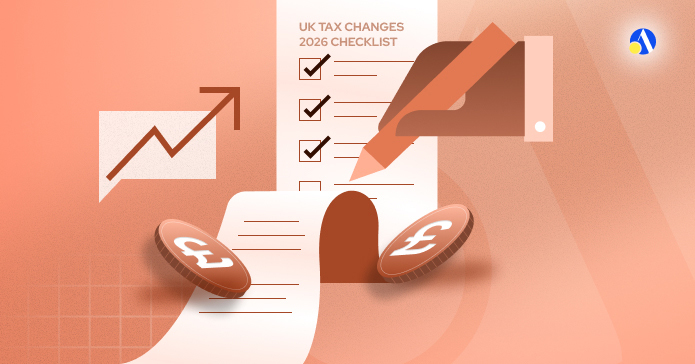
Nobody starts a business because they love filing tax returns. If you’re like most of the entrepreneurs and small business owners I work with, you’d rather be growing your client base than decoding HMRC updates.
But here’s the reality check: April 2026 is shaping up to be a massive pivot point for UK taxes.
We aren't just talking about a few percentage points here and there. We are looking at structural changes to how you report your income (hello, MTD), alongside freezes in allowances that act as "stealth taxes" on your hard-earned profits.
If you’re worried about what this means for your bottom line, you aren't alone. As an accountant, I spend half my day calming nerves about these exact shifts. The goal of this guide isn't to scare you—it's to give you the clarity you need to plan ahead so you aren't caught off guard when the new tax year rolls around.
Let’s break down the big five changes affecting your wallet in 2026.
Key Takeaways: What’s changing in 2026?
- Making Tax Digital (MTD) is finally here: If you earn over £50k, annual returns are out; quarterly updates are in.
- Dividends are getting expensive: Tax rates on dividends are jumping by 2 percentage points.
- Fiscal Drag is real: Tax thresholds remain frozen, meaning inflation and pay rises will push more income into higher tax bands.
- Penalty overhaul: A new points-based system will penalise late submissions more strictly.
- National Insurance shifts: Changes to Class 2 voluntary contributions are kicking in.
- Watch our video to find out more about it here
Table of Contents
- Making Tax Digital for ITSA: The Quarterly Shift
- The Dividend Tax Hike: Squeezing Company Directors
- Income Tax & Fiscal Drag: The "Stealth" Tax
- National Insurance: What Self-Employed People Need to Know
- The New Penalty Regime: Points Mean Prizes (and Fines)
- TL;DR Summary
1. Making Tax Digital for ITSA: The Quarterly Shift
You’ve probably heard the rumors about Making Tax Digital (MTD) for Income Tax Self Assessment (ITSA) for years. Well, the delays are over.
From 6 April 2026, if you are a sole trader or landlord with a total qualifying income over £50,000, the old way of filing once a year is gone.
What does this actually mean for you?
Instead of panic-filing a Self Assessment tax return in January, you will need to keep digital records and use compatible software to send updates to HMRC every quarter.
- Quarterly Updates: You submit a summary of your business income and expenses every three months.
- End of Period Statement (EOPS): You finalise the year’s data.
- Final Declaration: This replaces the old tax return.
Why it matters: This is a massive administrative shift. If you’re still using a shoebox for receipts or a basic Excel spreadsheet, you need to upgrade to cloud accounting software now. April 2026 is the start date, but you need your systems running smoothly well before then.
Pro Tip: Don’t wait until March 2026 to find software. Start testing digital tools now to see what works for your workflow.
2. The Dividend Tax Hike: Squeezing Company Directors
For years, paying yourself a small salary and taking the rest in dividends was the most tax-efficient way to run a Limited Company. While it’s still effective, the gap is closing.
Following announcements in the Autumn Budget, Dividend Tax rates are increasing by 2 percentage points from April 2026.
The New 2026/27 Dividend Rates:
| Rate Type | Old Rate | New Rate |
| Basic Rate | 8.75% | 10.75% |
| Higher Rate | 33.75% | 35.75% |
| Additional Rate | 39.35% | 39.35% |
The Impact on Your Wallet
The tax-free dividend allowance remains a meagre £500. This means almost every penny of profit you extract from your company (above that £500) is going to be taxed at a higher rate than you’re used to.
If you are a director taking £40,000 in dividends, this change will noticeably increase your tax bill. It’s vital to speak to your accountant about profit extraction strategies—pension contributions might look a lot more attractive this year.
3. Income Tax & Fiscal Drag: The "Stealth" Tax
You might see headlines saying "Tax Rates Not Rising," but don't let that fool you. We are dealing with Fiscal Drag.
The Personal Allowance (the amount you earn tax-free) is frozen at £12,570, and the Higher Rate threshold is frozen at £50,270. These freezes are now extended until 2031.
Why is a freeze bad news?
Because of inflation. As you (hopefully) increase your prices or grow your revenue to keep up with the cost of living, you aren't actually getting richer in real terms, but you are crossing into higher tax bands.
- The 40% Trap: If your profits nudge just £1 over £50,270, you instantly start paying 40% tax (plus 2% National Insurance) on that extra income. Check its consequences more in-depth here.
- Loss of Child Benefit: If your individual income creeps over £60,000, you start losing Child Benefit via the High Income Child Benefit Charge.
- The 60% Trap: If you hit £100,000, you start losing your Personal Allowance, resulting in an effective tax rate of 60%.
In 2026, more business owners than ever will be "dragged" into these higher brackets purely due to inflation.
4. National Insurance: What Self-Employed People Need to Know
National Insurance (NI) has been a rollercoaster lately. For the 2026/27 tax year, here is where we stand for the self-employed (Sole Traders):
Class 2 NI: The government is changing how voluntary contributions work. From 6 April 2026, individuals working outside the UK will no longer be able to pay Class 2 NICs voluntarily to protect their state pension record.
Class 4 NI: You continue to pay this on your profits. To find out more about class 4 NI, take a look at here.
- 6% on profits between £12,570 and £50,270.
- 2% on profits over £50,270.
Note for Limited Companies: Employer Class 1 National Insurance remains at 15%. However, the Employment Allowance (which allows eligible small businesses to reduce their Employer NI bill) sits at £10,500. Ensure you are claiming this if you are eligible—it’s free money essentially left on the table if you miss it.
5. The New Penalty Regime: Points Mean Prizes (and Fines)
HMRC is modernising how they punish late submissions, and this aligns directly with the MTD rollout in 2026.
They are moving to a points-based penalty system for late submission of tax returns.
| Feature | How It Works |
| Points | You receive a point for every missed submission deadline (e.g., a quarterly MTD update). |
| Thresholds | Once you reach a certain point threshold, you will receive a £200 penalty. |
| Late Payment | Separate penalties apply for paying tax late. There is no penalty if you pay within 15 days, but this increases after 30 days. |
| Aspect | Old Penalty System | New Penalty System |
| Trigger for Penalty | Immediate financial penalty for late filing. | Points-based system; penalty triggered only after threshold is reached. |
| Penalty Amount | Incremental penalties depending on the duration of delay. | £200 penalty once point threshold is reached. |
| Grace Period | No formalised grace period for late filing. | Allows a build-up of penalty points before issuing a fine. |
| Accumulation of Penalties | Penalties accrue directly with each late submission. | Points reset after 24 months of compliance. |
| Focus | Directly punitive for each missed deadline. | Encourages compliance by tracking a pattern of late submissions before penalizing. |
| Late Payment Penalty | Separate charges, depending on how late the payment is. | Remains separate; no penalty if paid within 15 days, increases after 30 days. |
This is designed to target repeat offenders rather than those who make a one-off mistake. However, with quarterly reporting under MTD, there are four times as many deadlines to miss. Staying organized in 2026 isn't optional; it’s a financial survival skill.
Conclusion: Don't Panic, Just Prepare
Looking at this list, 2026 looks expensive and admin-heavy. I get it—it feels like the goalposts keep moving. But knowledge is power.
By understanding that dividends are getting pricier, you can look at alternative remuneration strategies. By knowing MTD is starting for earnings over £50k, you can implement Xero or QuickBooks now, rather than stressing in April.
The businesses that thrive in 2026 won't be the ones ignoring these changes; they’ll be the ones who baked them into their business plan today. Be one of them now!
Summary
- MTD for ITSA: Mandatory quarterly reporting starts April 2026 for income >£50k.
- Dividends: Tax rates rising to 10.75% (Basic) and 35.75% (Higher).
- Allowances: Personal Allowance and tax bands frozen until 2031 (Fiscal Drag).
- Penalties: New points-based system for late filings.
- Action: Get cloud accounting software now and review your salary/dividend split.