



 3rd September 2026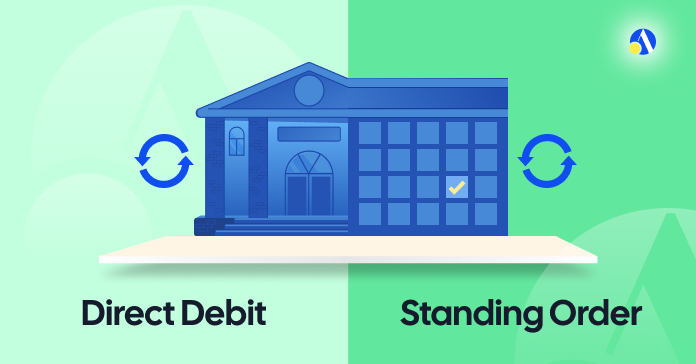
Short Answer: A standing order is a fixed payment that you set up and control through your bank, sending the same amount on the same date each time. A Direct Debit is a payment instruction you authorise, but the receiving company controls the amount and timing, within limits set by the Direct Debit Guarantee. Standing orders suit fixed payments like rent. Direct Debits suit variable bills like utilities.
Key Takeaways
- The difference between direct debit and standing order comes down to control: you control a standing order, a business controls a Direct Debit.
- Standing orders are best for fixed, predictable payments like rent, savings transfers, or membership fees.
- Direct Debits work best for variable payments like utility bills, subscriptions, or invoices with changing amounts.
- Direct Debits come with the Direct Debit Guarantee, giving you an automatic refund if the wrong amount is taken. Standing orders don't offer this protection.
- If you're a small business trying to decide between the two, your customer base size and billing structure should guide your choice.
In 2024, UK banks processed 560 million standing orders, according to UK Finance, with that figure expected to climb to 596 million by 2034 (UK Finance, Payment Markets Report). Meanwhile, the Bacs system processed 5.03 billion Direct Debits in 2025 alone (Pay.UK). Two payment methods, both automatic, both wildly popular, and yet most people (including some business owners who really should know better) still can't tell you the difference between direct debit and standing order.
I've had clients come to me convinced they'd set up a Direct Debit for their rent, only to find it was a standing order all along. It's an easy mix-up. Both sit quietly in your banking app, both move money automatically, and both feel identical from your phone screen. But the mechanics behind them are completely different, and getting it wrong can cost you time, money, or a very awkward conversation with your landlord.
Here's what you actually need to know.
What Is a Standing Order?
A standing order is an instruction you give directly to your bank to pay a fixed amount to a specific account on a set date, at a regular frequency: weekly, monthly, quarterly, or yearly. You set it up, you control it, and only you can change or cancel it.
Common examples include rent payments, savings transfers, gym memberships, and family allowances. Because the amount never changes, standing orders work brilliantly for bills that stay the same every time.
What Is a Direct Debit?
A Direct Debit is different. Here, you authorise a business or organisation to collect payments directly from your bank account. The company decides when and how much to take, provided they give you advance notice of any changes. This is why your electricity bill, mobile phone contract, and Netflix subscription almost always run on Direct Debit rather than standing order; the amounts fluctuate.
What Is the Difference Between a Standing Order and a Direct Debit?
The core difference between standing order and direct debit boils down to who's in the driver's seat.
| Feature | Standing Order | Direct Debit |
| Who sets it up | You, via your bank | The business, with your authorisation |
| Who controls the amount | You | The business |
| Payment amount | Fixed | Can vary |
| Changing the payment | You must cancel and set up a new one | Business can adjust with notice |
| Notification of failure | None, you have to check manually | Automatic, straight away |
| Consumer protection | None dedicated | Direct Debit Guarantee |
| Typical use | Rent, savings, subscriptions with fixed fees | Utilities, phone bills, credit cards |
| Cost | Usually free | Usually free for the payer |
Why Would You Use a Standing Order?
You'd choose a standing order when you want full control over a fixed, recurring payment. It suits situations where:
- The amount never changes (rent, mortgage overpayments, savings pots)
- You don't want a business dictating when or how much leaves your account
- You're sending money to family, friends, or a small club with no formal billing system
- You run a small operation (typically fewer than 25 customers) and don't need specialist payment software
Standing orders also cost nothing to set up in most cases, which makes them appealing for straightforward, predictable transfers.
Does a Standing Order Go Out Automatically?
Yes, once it's set up, a standing order runs on autopilot. Your bank sends the specified amount on the specified date, every time, without you lifting a finger.
The catch? It doesn't adapt. If your rent goes up by £50 a month, your standing order won't know that. You'll need to log into your banking app and manually update the amount, or cancel the old one and create a new one. It also won't tell you if a payment fails; you'll only find out by checking your statement, sometimes weeks later.
What Are the Disadvantages of a Standing Order?
Standing orders aren't perfect. Here's where they fall short:
- No failure notifications. If a payment doesn't go through, you won't hear about it, you'll need to check your bank statement to catch it.
- Rigid amounts. Any change means cancelling and starting again, rather than a simple adjustment.
- No dedicated protection scheme. Unlike Direct Debits, there's no Direct Debit Guarantee equivalent if something goes wrong.
- Risky for businesses collecting payment. Customers can cancel or change a standing order without telling you, leaving you chasing missing income.
- Manual admin. If you're relying on standing orders for business income, you'll likely need to check your account daily to confirm payments have landed.
What Are the Disadvantages of Direct Debit?
Direct Debits solve most of those problems, but they come with their own trade-offs:
- You give up control. The organisation decides the amount and timing, which some people find uncomfortable, even with advance notice built in.
- Reliance on your account balance. If funds aren't available when the Direct Debit is due, your bank may refuse the payment or push you into an overdraft.
- Setup complexity for businesses. Companies collecting via Direct Debit typically need a Service User Number and specialist software linked to the Bacs network; not something you can set up on a whim.
- Occasional chargeback risk. In rare cases, disputed payments can be reversed, which creates admin for the business collecting the money.
Standing Order vs Direct Debit: Which Should You Choose?
Choose a standing order if the amount you're paying (or collecting) never changes and you value control over flexibility. Choose a Direct Debit if the amount varies, you want automatic failure notifications, or you're a business that needs predictable, protected income from a larger customer base.
TL;DR
- Standing orders are set up and controlled by the payer, best for fixed amounts.
- Direct Debits are set up by the payer but controlled by the receiving business, ideal for variable bills.
- Direct Debits carry the Direct Debit Guarantee. Standing orders don't have an equivalent protection.
- Standing orders lack failure notifications. Direct Debits notify you almost immediately.
- Your choice should depend on whether your payment amount is fixed or variable, and how much control you want to hand over.
How Debitam Can Help You
Getting your payment methods right matters, but it's only one piece of running a financially healthy business. Whether you're setting up recurring payments for clients, managing cash flow, or just trying to keep HMRC and Companies House off your back, having the right support makes all the difference.
At Debitam, we support over 26,000 small businesses across the UK, with excellent Trustpilot ratings of 4.8/5 from 6,200+ reviews. We help you stay compliant, avoid unnecessary penalties, and get clear answers to exactly this kind of question: fast, plainly explained, no jargon. If you're not sure whether your current payment setup is serving your business properly, get in touch with our team today. We're here to sort it, not overcomplicate it.
FAQ about Difference between Standing Order and Direct Debit
Is a standing order safer than a Direct Debit?
Not necessarily. Direct Debits come with the Direct Debit Guarantee, which refunds you automatically if an incorrect amount is taken. Standing orders don't have this dedicated protection, though you're still covered by general Payment Services Regulations.
Can I switch from a standing order to a Direct Debit?
Yes. You'll usually need to cancel the standing order with your bank and set up a new Direct Debit mandate with the organisation you're paying.
Do standing orders cost money?
Most UK banks offer standing orders free of charge for personal accounts, though some may apply small fees for business accounts.
What happens if I don't have enough money for a Direct Debit?
Your bank may refuse the payment or allow it and place you into an overdraft, depending on your account terms. Either way, you'll usually be notified quickly.
Which is better for a small business collecting payments?
It depends on your customer numbers and billing structure. Standing orders can work for a handful of trusted customers paying fixed amounts. Once you're collecting from more than 25 customers, or your amounts vary, Direct Debit becomes far more practical.




 for seamless and stress-free
