



 10th September 2026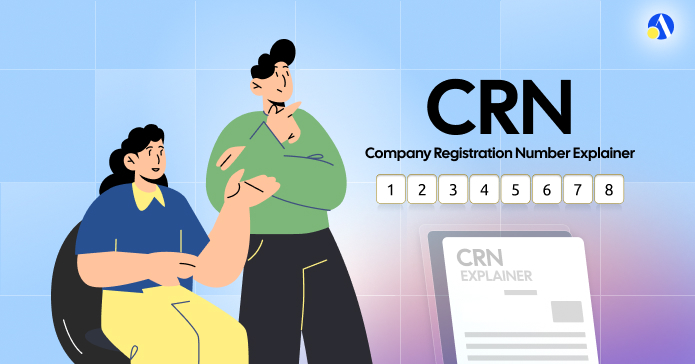
Key Takeaways:
- A CRN is a unique 8-character identifier assigned to your company by Companies House the moment it's incorporated
- Only limited companies and LLPs receive a CRN; sole traders and general partnerships do not
- Your CRN never changes, even if you rename the company or move your registered address
- You must display your CRN on your website, invoices, emails, and all official business documents
- A CRN is not the same as your UTR, VAT number, or PAYE reference; each serves a different purpose
- You can find your CRN on your certificate of incorporation or via the free Companies House public register
There are currently 5,450,364 companies on the Companies House register (as of December 2025, according to GOV.UK). Each one has a unique number that follows it forever. That number is the CRN, and if you run a limited company, it's one of the most important identifiers your business has.
Most new company owners only think about the CRN when a bank asks for it, or when a form won't submit without it. But understanding what a CRN is, where to find a company registration number, and when you need a CRN can save you real headaches down the line.
Here's everything you need to know about a company registration number.
What Is a CRN?
A company registration number (CRN) is a unique 8-character code issued by Companies House when your business is incorporated. You may also see it called a company number or Companies House number; all three terms refer to the same thing.
The CRN is the primary way Companies House identifies your company. It links your business to every statutory filing, public record, and compliance deadline associated with it. Even if you change your company name, move your registered office, or swap out every director, the CRN stays the same.
Two companies can have the same name. They will never have the same CRN.
You'll use it when you:
- Register for Corporation Tax with HMRC
- File your annual accounts and confirmation statements
- Open a business bank account
- Apply for credit or finance
- Display your details on your website, invoices, and official correspondence
Failing to include the required company information on business documents can put a company in breach of its legal disclosure requirements.
Is a Company Number the Same as a CRN?
Yes. "Company number" and "CRN" are used interchangeably in the UK. Companies House itself refers to it as a company number on its register, while accountants and banks more commonly say CRN. There is no difference between the two.
What Does a CRN Number Look Like?
A CRN is always 8 characters long. The exact format depends on where your company was incorporated and what type of entity it is.
| Jurisdiction | Entity Type | CRN Format | Example |
| England & Wales | Limited Company | 8 digits | 12345678 |
| England & Wales | LLP | OC + 6 digits | OC123456 |
| Scotland | Limited Company | SC + 6 digits | SC123456 |
| Scotland | LLP | SO + 6 digits | SO123456 |
| Northern Ireland | Limited Company | NI + 6 digits | NI123456 |
| Northern Ireland | LLP | NC + 6 digits | NC123456 |
If you see a number and aren't sure whether it's a CRN, UTR, or VAT number, the format will usually tell you. A UTR is 10 digits (issued by HMRC). A VAT number is 9 digits, often with a "GB" prefix. A CRN is always 8 characters.
How Do I Find My Company Registration Number?
If you've misplaced your CRN, don't worry, it's not gone. Here's where to look:
1. Your Certificate of Incorporation
This is the first document Companies House issued when your company was registered.
Your CRN appears clearly near the top. Keep a digital copy of your certificate of incorporation somewhere safe.
2. The Companies House Public Register
Head to find-and-update.company-information.service.gov.uk and search your company name. Your Company Number (CRN) will appear at the top of your company profile. No login required, completely free.
3. Official Companies House Correspondence
Any letter, reminder, or filing notice from Companies House will include your CRN.
4. Your Accountant or Formation Agent
If someone helped you set up your company, they'll have your CRN on file. At Debitam, you'll never have to worry about losing any.
5. Your Own Business Documents
Check your invoices, email footers, or website; if you've been displaying your CRN correctly, it's already there.
Do I Need a Company Registration Number as a Sole Trader?
No. Sole traders do not have a CRN.
A CRN is only issued to businesses that incorporate, meaning they register as a separate legal entity at Companies House. Sole traders operate as individuals and register with HMRC instead, not Companies House.
As a sole trader, you'll use:
- A UTR; issued by HMRC for Self-Assessment tax purposes
- A VAT number; if your turnover exceeds the registration threshold
If you're a sole trader and someone asks for your "company registration number," what they usually want is your UTR. Clarify before you guess, putting the wrong number on a form wastes everyone's time.
That said, if you decide to incorporate and form a limited company, you'll be issued a CRN automatically at the point of registration.
Does a Partnership Have a Company Registration Number?
| Partnership Type | Has a CRN? | Registered With |
| General (ordinary) partnership | No | HMRC |
| Limited Liability Partnership (LLP) | Yes | Companies House |
| Limited Partnership (LP) | Yes | Companies House |
A general partnership; two or more people trading together without incorporating, does not have a CRN. Like sole traders, general partners register with HMRC and are identified by a UTR.
An LLP, however, is a different matter. Limited liability partnerships are incorporated at Companies House and receive a CRN in the same way a limited company does (with the "OC" prefix for England and Wales).
If you're unsure which structure your business operates under, check whether you have a certificate of incorporation. If you do, you have a CRN. If you don't, you likely don't.
How to Get a Company Registration Number?
You don't apply for a CRN separately. It's issued automatically when your company is incorporated.
To get one, you need to register a limited company or LLP with Companies House. You can do this:
- Online via GOV.UK; typically processed within 24 hours
- With Debitam; who handles the process on your behalf, saving you time and money
- With Debitam; who handles the process on your behalf, saving you time and money
Once Companies House approves your application, you'll receive a certificate of incorporation, which includes your CRN. From that moment on, the number is yours permanently.
You cannot choose or request a specific CRN. It's computer-generated and assigned based on the registration sequence.
CRN vs Other Business Identifiers
One of the most common sources of confusion is mixing up the CRN with other business numbers. Here's a quick reference:
| Identifier | Issued By | What It's For |
| CRN (Company Registration Number) | Companies House | Legal identity of the company |
| UTR (Unique Taxpayer Reference) | HMRC | Corporation Tax and Self-Assessment |
| VAT Number | HMRC | Charging and reclaiming VAT |
| PAYE Reference | HMRC | Payroll and employee tax |
| Companies House Authentication Code | Companies House | Submitting filings online |
These are not interchangeable. Entering a UTR where a CRN is expected will result in an error - and potentially a delayed filing.
TL;DR - Everything about Company Registration Number in 60 Seconds
- A CRN (company registration number) is an 8-character identifier issued by Companies House when you incorporate
- It's permanent - it never changes, regardless of name or address updates
- Limited companies and LLPs have CRNs; sole traders and general partnerships do not
- Find yours on your certificate of incorporation, via Companies House online, or on official correspondence
- You must display it on your website, invoices, emails, and business letters under the Companies Act 2006
- Don't confuse it with your UTR, VAT number, or PAYE reference — they serve completely different purposes
How Debitam Can Help
If you've just incorporated, are thinking about forming a limited company, or simply need to get your compliance in order, Debitam's team of online accountants can help.
If you've just incorporated, are thinking about forming a limited company, or simply need to get your compliance in order, Debitam's team of online accountants can help. 6,000 reviews, Debitam works with small business owners who want reliable, jargon-free support, without the hourly rate and no hidden fees.
Got questions about your CRN, your filing obligations, or what comes next after incorporating? Get in touch with Debitam today.






 for seamless and stress-free
