


 15th October 2026
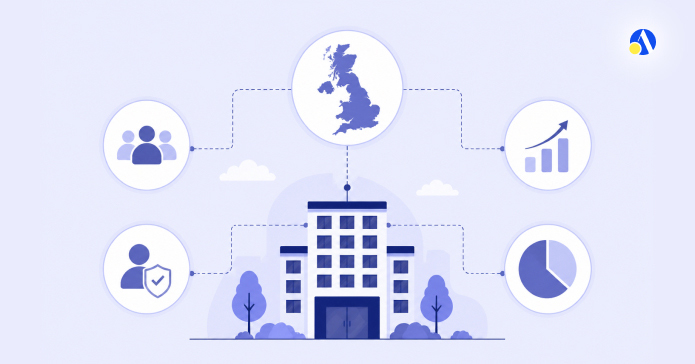
Quick answer: A PLC (public limited company) is a UK business structure that can sell shares to the public and must hold at least £50,000 in share capital, with 25% paid up before trading. PLCs have stricter reporting rules than private limited companies (Ltds) but gain easier access to public investment and a stronger market profile.
Key takeaways
- A public limited company can offer its shares to the public through a stock exchange; private companies (Ltds) legally cannot.
- Here's the fact most people miss: a PLC doesn't have to be listed on any stock exchange at all. You can form an "unlisted" PLC and never touch the London Stock Exchange.
- PLCs need a minimum of £50,000 in allotted share capital, with at least £12,500 (25%) paid up before the company can start trading or borrowing (Companies Act 2006, s.763, s.586).
- You'll need at least two directors and a qualified company secretary; Ltds only need one director and no secretary.
- Before trading begins, a newly formed PLC must apply to Companies House for a trading certificate.
Right, let's get into it properly.
What is a PLC in simple terms?
If you've ever wondered "what's a PLC" while scrolling through Companies House filings or spotting the letters after a brand name on the high street, here's the straightforward answer: a PLC, or public limited company, is a type of limited company registered under the Companies Act 2006 that's allowed to sell its shares to members of the public.
That's the headline feature. Private limited companies (Ltd) are banned from offering shares to the public under section 755 of the Act; only a PLC can do that. So when someone asks what a PLC actually means, the short version is: it's permission to raise money from public investors, paired with a stack of extra legal obligations to protect them.
The name itself has to reflect the structure too. Companies House requires a PLC's company name to end in "public limited company" or "PLC" (or the Welsh equivalents "cwmni cyfyngedig cyhoeddus" or "CCC").
What is a PLC in business?
In a business context, PLC business structures are usually chosen by companies that have outgrown the private model and need serious capital to fund expansion, acquisitions, or an eventual stock market listing.
The meaning of a PLC that company owners should understand is less about size and more about access: access to public investors, access to higher borrowing power, and (for some) access to a listing on the main market or AIM.
That said, not every PLC is a household name. There are several types of public limited company:
- Listed PLCs: shares trade on a recognised exchange like the London Stock Exchange's main market or AIM.
- Unlisted PLCs: registered as a PLC but shares aren't traded on any exchange. Yes, this is genuinely allowed.
- Re-registered PLCs: private companies that converted using Companies House form RR01.
- PLCs formed from scratch as public companies from day one.
Well-known UK examples of listed PLCs include Tesco PLC, Barclays PLC, Unilever PLC, HSBC Holdings plc, Vodafone Group Plc, BP p.l.c., and Rolls-Royce Holdings plc - but remember, plenty of lesser-known PLCs never list publicly at all.
Who controls a public limited company?
Shareholders own a PLC and elect its board of directors. The directors then run the business day-to-day and are accountable to the shareholders. Anyone holding more than 25% of shares or voting rights is classed as a Person with Significant Control (PSC) and must be registered with Companies House.
For premium-listed PLCs, the UK Corporate Governance Code also applies on a comply-or-explain basis, adding another layer of oversight from the Financial Reporting Council.
Public limited company advantages and disadvantages
Let's be honest with you, a PLC isn't automatically "better" than an Ltd. It depends entirely on what your business needs.
Benefits of a public limited company
- Access to capital: the single biggest advantage of a PLC is being able to raise funds by selling shares publicly, including to international investors.
- Credibility and profile: listing on an exchange can boost brand recognition and investor confidence.
- Share transferability: PLC shares are freely transferable, which makes them useful for attracting and rewarding talent through share schemes.
- Limited liability: like an Ltd, shareholders' risk is capped at what they've invested - the company remains a separate legal entity.
These public limited company benefits explain why fast-growing or capital-hungry businesses consider the switch. But, and this matters, those same advantages of PLC business come at a cost.
Drawbacks of a public limited company
- Higher minimum share capital (£50,000, 25% paid up) before you can even start trading.
- Stricter reporting and disclosure requirements than private companies.
- Must file accounts within 6 months of the year end, versus 9 months for an Ltd.
- Must hold an Annual General Meeting (AGM) within 6 months of the financial year end.
- Requires at least two directors and a qualified company secretary.
- Market value can be volatile, and founders risk losing control through share dilution.
Public limited company liability
Wondering how public limited company liability actually works? It's the same as for an Ltd, and it's a point that trips up a lot of business owners.
- Limited liability: Shareholders are only liable up to the amount unpaid on their shares.
- Separate legal entity: The company itself carries the risk, not you personally.
- Personal assets: Your personal assets aren't automatically on the line if things go wrong, provided you've met your legal obligations as a director.
What's the difference between Ltd and PLC?
Here's where the real decision-making happens. The differences between Ltd and PLC come down to public access to shares, minimum capital, and governance.
| Feature | Private Limited Company (Ltd) | Public Limited Company (PLC) |
| Can sell shares to the public | No | Yes |
| Minimum share capital | None (commonly £1) | £50,000 allotted, 25% paid up |
| Minimum directors | 1 | 2 |
| Company secretary | Not required | Required (qualified) |
| Accounts filing deadline | 9 months after year end | 6 months after year end |
| AGM required | No | Yes, within 6 months of year end |
| Trading certificate needed | No | Yes, before trading or borrowing |
| Name suffix | "Limited" or "Ltd" | "Public Limited Company" or "PLC" |
A private company can convert to a PLC by filing form RR01 with Companies House, alongside a special resolution and the current filing fee. It's also possible to go the other way; a PLC can re-register as private using form RR02.
What is a PLC in the UK?
What is a PLC in the UK? In short, a PLC (public limited company) is a company structure governed by the Companies Act 2006. Here's what sets it apart:
- Public share sales: A PLC can offer its shares to the public. A private limited company (Ltd) can't.
- Share capital: You'll need at least £50,000 in allotted share capital before you can start trading.
- Stricter reporting: Expect tougher filing and reporting duties than a private Ltd.
- Registration: Like an Ltd, it's registered with Companies House, but it follows a different rulebook once it's formed.
Worried you'll have to list on a stock exchange? You don't. Whether to list is entirely your decision.
TL;DR
A PLC (public limited company) can offer its shares to the public. A private Ltd can't. Here's what you need before you start trading:
- Share capital: At least £50,000 in allotted share capital, with 25% paid up
- Directors: A minimum of two
- Company secretary: One who is suitably qualified
- Trading certificate: Required before you trade
- What's the trade-off? Reporting deadlines are tighter, and governance expectations are higher. In return, you get wider access to capital and stronger investor credibility.
- Do you have to list on a stock exchange? No. A PLC doesn't need to be listed to exist, so unlisted PLCs are entirely valid.
Thinking about restructuring? Don't go it alone
Converting to a PLC or simply keeping your existing company compliant isn't a DIY job you want to get wrong.
Confirmation statements, accounts deadlines, and director or PSC identity verification requirements under the new ECCTA rules are tightening, and penalties for missing them are real.
That's where Debitam comes in. We handle confirmation statement filing, company secretarial services, and accounts filing support, so nothing slips through the cracks and we help you stay ahead of ECCTA's new identity verification and filing requirements before they catch you out. Over 6,000 reviews on Trustpilot back up what our clients already know: compliance doesn't have to be stressful.
Get in touch with Debitam today and let us handle the filings while you focus on running your business.
FAQs about Public Limited Companies in the UK
You'll need at least £50,000 in allotted share capital, with £12,500 (25%) paid up before trading begins, plus the standard Companies House registration fee and any professional fees for drafting your memorandum and articles.
Timelines vary depending on whether you're forming a new PLC or re-registering an existing private company (form RR01). Either way, you'll need a trading certificate from Companies House before you can legally trade or borrow money.
The main risks are higher compliance costs, stricter reporting deadlines (accounts due within 6 months versus 9 for an Ltd), mandatory AGMs, and potential loss of founder control through share dilution.
For most small and medium businesses, yes. An Ltd offers limited liability without the £50,000 capital requirement, mandatory company secretary, or public disclosure burden, making it the more practical choice until you genuinely need public investment.
PLCs suit businesses that need substantial capital for expansion, want the credibility of a public profile, or are preparing for an eventual stock exchange listing. If you don't need public investment, the extra compliance burden usually isn't worth it.



 for seamless and stress-free

